Nick & Choose 20: Chick Flicks

Published Feb. 3, 2010

View as PDF

Film School
Nick’s chick-flick survival guide

Women fully embrace the term “chick flick.” That was the first surprise as I began my research, and it’s the fact that may prove key to the whole enterprise.

For the ladies, let me explain the central conceit to guys’ movies: They appeal to our survival fantasies. Pit one man (Under Siege) or men (Hoosiers) against seemingly insurmountable odds (terrorists, South Bend Central High School), and you have a film that we’ll quote ad nauseam decades after its release.

For the men, deciphering what women see in chick flicks could help us endure the occasional saccharine overdose. So, like a cross between Roger Ebert and Jane Goodall, I took the apes to the movies. (First lesson: Women hate that analogy.)

My study began with My Sister’s Keeper, the story of a young girl with leukemia and the sister born to serve as her donor. With me was my friend Casey, who had read the book and informed me, “I started crying on page six. I couldn’t even finish the last chapter.” Can’t wait, I thought, opening the case to a film so sappy the DVD could’ve been made from candied maple syrup.

Before hitting play, I needed the ground rules. What should a guy do if his female companion starts to weep? “I would be insulted if you made fun of me—I know it’s ridiculous,” Casey said. “And don’t be like, ‘Oh, it’s OK.’ I’m not going to lose sleep tonight.” Yeah, but that wouldn’t be the worst time for a man to make a move, right? I mean, that’s part of the chick-flick appeal—there’s an element of romance. “I suppose you could take advantage if you really wanted to.” Well, that just makes it sound sordid.

As the cancer escalated and the voiceovers churned out lines like, “Everyone was so worried about my blood counts, they barely even noticed that Jesse was dyslexic,” the movie changed from chick flick to farce. So days later, I decided it was time to bring out the big guns: The Notebook and Susan, who had a feasible cinema theory of her own.

“You need relationship equality,” she explained. “In the bad ones, it’s mostly about the women, and the guy is a caricature: either Prince Charming or a dick.” Therefore Bride Wars = bad, (500) Days of Summer = good. In contrast, she had a second, less fair-minded idea: “I haven’t done the statistical analysis, but the people that champion crappy chick flicks are unhappy in their own relationships, or state of unrelationship—God, I sound like a horrible person.” Yes, you do, but it keeps me from stating such things.

Speaking of horrible, have you seen The Notebook? In terms of relationship equality, I found Rachel McAdams and Ryan Gosling identically irritating. Why is this the quintessential chick flick? According to Susan, “‘Cause Ryan Gosling is hot and manly and sexy and caring.” OK, OK, that’s enough.

Words delicately balanced between and advice and admonishment came as we settled down for my final trial. “It’s easy to make fun of The Notebook,” she said. “What’s not easy is letting yourself go.” It would be a task made difficult due to the next movie being The Proposal. I might like A-Rod more than Sandra Bullock.

But I found untapped mental muscle memory, developed through years of ESPN. Announcers like Joe Morgan make me want to ice-pick my ear drums, but I still watch sports. The key is active disengagement, a sifting for nuggets of interest amid intolerable sludge. While watching Bullock stomp around in red-soled heels, I compulsively uttered, “Oh, she’s wearing Blahniks.”

“No, those are Louboutins,” Susan corrected—she, clearly impressed, me, grateful I got that wrong.

Like a separate relationship issue, it helps to think about baseball. When you sit down and honestly pay attention to a game, there’s maybe four minutes of compelling content within a three-hour span of triviality. But you find what you like and accept the filler. And in the same way, women see the silliness in chick flicks. They just need men to do something we’re already trained for: Respect the absurdity.

Nick & Choose 19: Fitness Shoes

Published Jan. 6, 2010

View as PDF

Sole Man
Toning without the legwork

“Make your boobs jealous.” It’s the tagline in an ad for Reebok EasyTone shoes starring a pair of spectacular talking breasts. Perhaps you’ve seen the one with a woman writhing on bedsheets wearing nothing but her briefs and sneakers? The voice-over, I discovered after repeat viewing, promises up to 28 percent more of a workout for the butt and 11 percent more for the hamstrings and calves. While watching these commercials, one thing immediately came to mind: This objectification of women must stop! No, sadly the material prompted a desire much more indecent: I must have this women’s clothing for my own!

Purely for the sake of a shortcut. I think both sexes like things quick and easy, and if these fitness shoes can boost strength with minimal effort, I was going to give’em a shot. There are three brands that produce them, and as Reebok doesn’t yet make EasyTones for men, and not owning the Lee jeans necessary to pull of Sketchers, I went with a pair of MBT boots.

A Swiss company, MBT bills itself as “the anti-shoe.” Unlike EasyTone’s balance pod design, the MBT line creates instability with a curved sole. As all the companies claim, constantly working to stay balanced strengthens the supporting muscles. What they conveniently leave out is that their products look ridiculous.

“I feel like you have something wrong with you, like one of your legs is shorter than the other,” critiqued one coworker, as I modeled the latest trend. “Those are probably the shoes Tom Cruise wears to be as tall as the actresses.”

True, they’re not going to win you cool points, but on an ugly-as-sin scale, MBTs are more coveting your neighbor’s wife as opposed to sleeping with her. And besides, looking stylish was a petty concern. I had a tush to tone.

So I took off walking. With their hefty bowed sole, MBTs give new meaning to the term “boat shoe,” and on the 1.7-mile trek from the office to my apartment, I developed a pleasant bobbing rhythm. But I didn’t really feel anything. The next day I picked up the pace, thinking my stabilizing muscles may have just needed a warm-up, but in the morning I didn’t feel the tightness or fatigue associated with actual exercise. Staying centered while standing required a small amount of effort, but in terms of muscle work, it’s nothing my Restless Leg Syndrome wasn’t taking care of anyway.

The problem with these shoes is they have a great design for walking and a terrible shape for anything else. Shooting hoops in MBTs would be like playing soccer on a pogo stick. As I’m about 30 years away from walking actually counting as exercise, I felt hamstrung by my two-week trial. So I devised new ways to feel the burn.

One night I cranked the treadmill up to that ungainly limbo where walking teeters uncomfortably close to jogging and your oddly shaped shoes are maybe the fifth reason you look like an idiot. Over 30 minutes I walked 2.1 miles with the incline set as high as 15 percent. On the MBT website, the company equates walking in their shoes to walking on sand. Through experience, I know that the day after a hard hike on the beach, my calves should feel like they’ve been rubbed with honey and set upon by fire ants.

But my chicken legs went unslaughtered. The reason may be that as an active person, I’m ahead of the game. Professional research shows that balance balls have little effect on consistent exercisers. Some dodgy research proves these shoes stimulate your stems. While the MBT website provides scientific abstracts that support their claims, Reebok’s sole study tested just five people. In terms of credible sample sizes, that’s as if I set out to prove I was the world’s fastest man by racing four geriatrics from the local rest home.

There may, in fact, be some benefit to this new fashion in fitness, but in this expert’s opinion: Walk to work. Take the stairs, and be comfortable with what’s on your feet.

Nick & Choose 18: Kindle

Published Dec. 2, 2009

View as PDF

Light Me Up
Nick kindles his fears

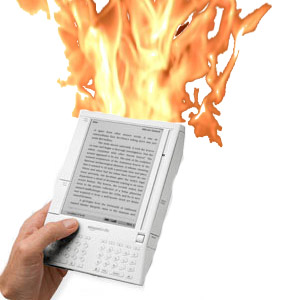
When not hard at work, I like to sit back and relax with a tangible reminder of the impending death of my industry.

The Internet has changed the way we consume the written word, but thanks to portability issues and expense, readers still have to pick up actual books, newspapers and magazines (thanks, suckers!). But like the song I illegally downloaded says, “Times, they are a-changing.”

We now have products like the Cybook, Foxit eSlick, iRex iLiad and the current king of the hill, the Kindle. Economics is a giant catalyst. Newspaper and book publishing was a 260-billion-dollar business, with half that cash used for things like paper, ink and transport. By moving the medium digitally, the industry can save the equivalent of the GNP of Pakistan. The environmentalist in me loves the reduction in deforestation and fuel consumption. The economist in me wonders why I eat out of cans when I work in a multibillion dollar industry.

In order to understand my enemy, I went to the Boston Athenaeum, borrowed a Kindle and tried it in a place where millions of Bostonians may soon use it: rush hour on the T. My first concern was that I’d look like an asshole, but as commuters have a well-honed ability to ignore assholes, no one seemed to notice. The immediate benefit I found is that because the Kindle is so light, and flipping the page only requires a button push, you can easily read with one hand while blocking frottage with the other. Plus, as there’s no book cover, you can read the latest Nicholas Spark’s novel guilt-free. And as one ear-bud-sharing, emo-sing-along reminded me on a trip home, sometimes you need noise in order to concentrate, and the Kindle has plenty of space for MP3s.

There are a lot of cool features on the device—from being able to wirelessly download titles to a hilarious text-to-speech function. You haven’t lived until you’ve heard Stephen Hawking narrate a fight scene. Of course the biggest benefit is the size. I took the Kindle on a flight to South America, and the woman next to me spent hours reading a leather-bound Bible and audibly praising Jesus as we landed, and all I could think was, “Damn, that book looks heavy.” On the way back, as I read my compact Kindle with my arms at a polite width, the spindly man next to me spread out the beach towel of his broadsheet as his elbows slid like glaciers across the controls of my TV. I wanted to introduce my Kindle to his colon, especially when my nap was shattered by 180 decibels of football highlights, but it would’ve cost me about $260.

With a built-in dictionary and the ability to wirelessly Google or Wikipedia words, it’d seem that the Kindle has taken all the effort out of sitting in an armchair, but there are some issues. First, flipping through a text can be incredibly slow and frustrating. The newspaper is bad, but the thought of a digital textbook makes me weep for future generations of college students who’ll also drink and party and not read their textbooks. Making notes is a snap, but nowhere near as easy as just writing in the margins. Active reading ends up feeling insular and finite. In the future, I want to pull Robert Parker’s Rough Weather down from the shelf and show a friend he actually wrote the sentence, “She looked like she was receiving an Academy Award for stunningness,” not have that friend wait while I pull it up from a hard drive.

And, to be honest, the shelf is my hang-up. Yes, I like to pretend I’m a big, smart man with lots of novels on display, but I also like the way books look and feel. Have you buried your nose in a book recently? Those things smell great, too. And the dream is to see your name in print, not liquid crystal. For now, Kindle is convenient, yet the book still carries weight. But unlike glorious, rent-paying city magazines, they may not be around forever.

Nick & Choose 17: Reiki

Published Nov. 4, 2009

View as PDF

Touch of Faith
When Nick gets that feeling, he needs spiritual healing.

A red flag goes up when I see techniques described as ancient, mystical or spiritual. For example, it’s hard for me to view cupping as anything more than light S&M with glassware, but I admit to never giving it a fair shot. On the other hand, having been punched in the face, I can attest that there’s something to kung fu.

It make take a millennium, but the truth eventually comes out with these things. Consider yoga, a practice now seen as more than stretching with style. In my mid-20s, I needed a new hobby/distraction, and yoga paid dividends. The same thing happened to Christine Radice, and her enthusiasm led her to Reiki. Rising in popularity, Reiki is a Japanese form of spiritual healing developed around 100 years ago. Radice, 35, is now a master practicing Reiki, and a seperate service called “angel healing,” in Oak Square. Experiencing the former would only require an open mind. The latter would take a longer leap of faith than I’m currently capable of making.

As it’s also known as Reiki massage, I was expecting the room in Radice’s house to be all soft lighting and softer furniture—the interior design equivalent of a fluffy bathrobe. Instead I entered a small, barren space tucked into a corner upstairs; the only objects on the creaking floorboards were a massage table, two tiny, wooden chairs and a small lamp emitting a few matches’ worth of light. Were Norman Bates to move to Brighton, this would be Mother’s room.

Thankfully, Radice has a warm personality. Before the session began, she broke down the process. By placing her hands on or around my chakras—believed to be the major energy centers of the body—she would help rebalance my ability to absorb the healing energy, or the stuff of life, around me. As a practitioner of a Buddhist form of Reiki called Reiki Jin Kei Do, communicating with passion is a key to her approach. It’s like a laying on of hands without the scary Old Testament stuff. In home TV-repair terms, she would be the tinfoil on my rabbit ears.

The session began with Radice placing her fingers on my forehead while I lay on my back. When describing her first experience, she said it felt like someone was pouring warm oil on her face. “I didn’t know this practitioner, but I felt a lot of compassion from her,” Radice explained. After a while, I had an odd sensation that she was gently pushing my head through the floorboards, but it was a spell easily broken by opening my eyes. Yet the room had become less eerie (although I won’t call it a product of transmissible compassion.)

As Radice worked a slow circle around my body, I fell in and out of a series of naps. This might seem like an odd occurrence during a massage aimed at energizing, but when you consider the themes of my dreams: two Westerns, a war story, something about Lawrence Taylor in the WWE and a disco song about bacon, maybe the stuff of life was channeling directly into my subconscious.

It total, the session felt like 45 minutes of intimate meditation, or some cross between prayer and a cuddle party. I can’t say I felt particularly vitalized, but it’s freeing to give yourself up to an hour of peacefulness. And Radice’s enthusiasm is hard to miss. “It really is an honor to share it,” she said afterward. “It’s mostly just being connected with compassion and being present with the person.” That I could feel, and whether Reiki works or not, there’s nothing faulty in the intention.

Nick & Choose 16: Pumpkin

Published Oct. 7, 2009

View as PDF

Get Pumped
Nick bites into fall’s favorite flavor

The menu is the new Farmer’s Almanac. When crates of clementines appear, it’s time to bundle up. When you’re dodging yet another volley of asparagus spears, the sweaters can head for storage. Used to be, sticking a wet finger in the air would tell you how the winds were changing. Now you just have to stick out your tongue.

No flavor marks a season more than pumpkin, a squash that has squeezed its way into everything from cheesecake to cocktails. But does the taste of a filthy, rigid warty fruit enhance these products? It was time to gorge.

My first stop was Starbucks for a pumpkin-spice latte, an endeavor that was doomed from the start. I drink coffee like a masochist, with each sip delivering a delicious jolt of pain and the chance to dirty-talk my java under my breath. Lattes are usually tepid, and while the pumpkin flavor in this one started sweet, there was an oddly salty finish. As one coworker remarked, “That would stay with me all day, in a bad way.”

If I was going to regret drinking something, it might as well get me drunk. So I moved to beer, perhaps the most popular and heterogeneous sector of pumpkin-flavored products. My friends Chris and SooAe—who’ve embraced adulthood more openly than the rest of my maturity-challenged pals—had thrown a dinner party. I didn’t attend, but the following morning I leapt out of my racecar bed to help them finish the booze.

We began with seven different beers, an array of glasses and one snooty observation: There’s no pumpkin in the bouquet. Chris decided Fisherman’s Pumpkin Stout has the aroma of coffee milk. Huffing the Weyerbacher Imperial Pumpkin Ale, SooAe decreed, “This smells like Crabtree & Evelyn.”

The reasoning is the seasoning, and when picking a pumpkin beer, what you should look for isn’t accuracy in flavor, but ingredients that best match your preference in pumpkin pie. If you like brown sugar, allspice, cinnamon and nutmeg, try Dogfish Head Punkin Ale. If you abhor flavor of any kind, try Blue Moon’s Harvest Moon. But congrats to Shipyard’s Pumpkinhead, this year’s winner of the Best Seasonal Vehicle for Inebriation Award.

Testing my pie theory, I went to Toscanini’s, where, due to pumpkin’s popularity, the flavor had sold out. “I’m obsessed with it,” said Alicia, behind the counter. “Fall and pumpkin go hand-in-hand.”

“But what we really want is pumpkin pie, right?”

She answered with an immediate, almost conspiratorial “yes.”

The girl at Lyndell’s Bakery was equally obsessed with their equally sold-out pumpkin cupcakes. “Last night, people were buying them four at time,” she explained, as her enthusiasm for their quality quickly clouded her acumen for salesmanship. “Because they’re like the pumpkin muffins at Dunkin’ Donuts. Have you had those? Oh my God, I live for them.”

On a return visit, I found that while the flavor could easily be carrot cake, Lyndell’s version does win points for presentation, with thick orange frosting, striations of green icing and a candy stem. Much like with the beer, inaccuracy in flavor didn’t hinder my guzzling.

In the end, the most faithful, and tasty, presentation was pumpkin soup from Da Vinci’s, which was the one thing I ingested that contained discernible pumpkin. Roasted and seasoned with cinnamon, nutmeg and ginger, the soup also included pancetta, allowing you to not only dust off the stock phrase “everything’s better with bacon,” but raise it to previously unfathomable levels of foodie pomposity.

Pumpkin is a tricky fruit. You can’t just pick one up and take a bite. But then again, you don’t see rhubarb lattes around, and unlike pumpkin, that ingredient is never going to win a pie popularity contest. Maybe it’s the color, maybe it’s that they make great lanterns. But I suspect we love pumpkins because they’re an excellent medium for cinnamon, cloves and allspice. Just stock up the cupboard, and you’ll have the flavors of fall year-round.

Nick & Choose 15: Trapeze

Published September 9, 2009

View as PDF

Living the High Life
Nick learns how to swing.

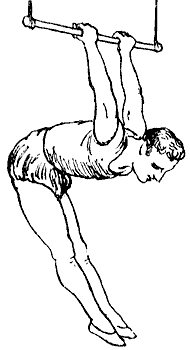
No one goes to the circus for the clowns. They’re more creepy than amusing. And no one goes to see the elephants. Maybe in the radio days, when an elephant up close was impressive, but now it’s just a sad, seven-ton beast in a headdress.

The true draw: the trapeze. It has acrobatics and finesse, but more than anything, there’s the scandalous, titillating prospect that you might see someone die.

Heights hold a natural yet terrifying attraction. After all, who hasn’t toed the edge of a precipice and, just briefly, entertained a crazy notion. What’s legitimately shocking is you’ll be doing exactly that within the first 20 minutes of your visit to Trapeze School New York’s local branch.

Located inside the Jordan’s Furniture in Reading, TSNY emphasizes safety, but definitely takes a push-you-into-the-pool approach to instruction. After some brief guidelines, you’re up on a 24-foot platform with no time to pause and wonder “How’d that guy at the front desk get that scar on his head?” That’s good, because on my first routine I swung upside down by my knees and dismounted with a back flip, which felt like trying to learn math and having the teacher skip counting in favor of calculus.

Trapeze seems like a simple combination of goals: Appear graceful and survive. But you soon discover some surprising revelations.

The stuff that looks hard is easy, and the stuff that looks easy is hard. I’ve never done a back flip in my life, but it’s simply a way to seem cool while falling. Just hanging on, though, can be a literal pain, as centrifugal force stomps your hands like an action movie villain. And while you’re concentrating on seemingly important tasks like looping your legs around the bar, things you hadn’t considered, like when to make your initial jump, are the crucial elements to maintaining a rhythm.

Trapeze school isn’t aerobically tiring, but elicits strong physical reactions. My feet don’t often sweat, but I was soon glad to have chalk to rub on appendages other than my hands. It takes a few skipped showers for me to build up B.O., but after two hours, I had a definite musk. Each series of swings is a burst of adrenaline, and for all its intoxicating benefits, adrenaline is a sweat-and-stink-inducing hormone.

With a few passes under my belt, I started to relax and focus on circumstances somehow more absurd than trapezing above the lobby of a furniture emporium. Like how I ended up in line behind a guy who went to circus camp in fifth grade. He was making me look bad. Also in the complaints department were the liquid fireworks, a fountain and light show that gave the proceedings an admittedly badass background. But while circus boy flew to a soundtrack featuring the music from Superman or Chariots of Fire, my turns always coincided with heart-thumping numbers like Michael Jackson’s “Heal the World.”

In my final two runs, instead of a normal dismount, I was supposed to hang by my knees, arch my back, stretch out my hands and be caught by an instructor swinging on an adjacent trapeze. Success hinged on the simple act of presenting my partner with “sevens,” or firm, open palms with thumbs extended.

My opening run was majestic. I seamlessly tied together my moves, arched my back and then…put out my hands like a lady awaiting a kiss from an upside-down suitor. “Sevens!” I heard as I fluttered down to the netting.

It was courageous of me to sacrifice a turn in order to prove the importance of sevens to my classmates, and after each one succeeded, I ended the day with a triumphant run of my own. As I bounced off the mat, I realized that my life needs more exuberant fist pumps. But unless I really get into ottomans, it’s probably my last one in a furniture store.

Nick & Choose 14: Horoscope

Published August 12, 2009

View as PDF

Constellation Prize
Nick greets the dawning of four days of Aquarius

I put too much stock in my psychic abilities. If I catch myself thinking, “Whatever happened to Ogre from Revenge of the Nerds?” and then I later see him playing a barbarian in a Capital One ad, I feel like I’ve somehow conjured him into existence.

With such far-reaching powers as the ability to get D-list actors work, I’ve never held much faith in the clairvoyance of others. Tarot cards, tea leaves, Magic 8 Balls, there are too many options, and they can’t all be right. When I was a kid, a palm reader at a county fair told me I was a good boy, and if I didn’t use drugs, I’d turn out fine. Thanks for nothing, lady.

Deciding to further explore soothsaying, I consulted Eugenia Last’s Astrological Forecast in The Globe, because if you can’t find valuable guidance next to Doonesbury, really, where can you turn? I gave Eugenia four days.

Monday: “Good things will come from an unexpected source. A friend will be there to back you if you need help and encourage you to follow through with your plans.”

Nothing good arrived, which proved the forecast both inaccurate and depressing, but my friend John did come over to help me in my plan to install an air conditioner. Of course pieces were missing, so there was no real follow-through. It seems even though a friend came to my aid, the universe (and Sears) was still there to screw me. And now I have a wobbly window unit one unlucky nudge away from plummeting to the sidewalk. Hopefully my future doesn’t hold involuntary manslaughter charges. Horoscope accuracy (out of 5): 2.5.

Tuesday: “Someone you thought you knew well will let you down.”

Do I have good friends or bad, horoscope? Make up your mind.

That night my friend Adam and I lucked into luxury box seats at Fenway, and as Adam savored our 6-2 lead and his fourth Heineken, he said, “I hope this game goes into extra innings.” Of course we blew the lead and ending up
losing in the 11th, but I already knew that would happen. The man is a military-grade jinx—but apparently better at predicting the future than Eugenia Last. Accuracy: 1.

Wednesday: “Be honest about what you did and didn’t contribute or you may be questioned or put in an awkward position.”

It’s date night, and a time when I would rather pour the soup du jour down my pants than be forthright, so bring on the awkwardness!

Nothing. After a few jokes and some lively repartee about mass homicide and organ donation, I came across as charming as always. Dodged another of your feeble bullets, zodiac. Accuracy: 0.

Thursday: “You can open doors that have been closed in the past.”

Giving my horoscope one last chance, I made a concerted effort and decided to call a friend I hadn’t spoken to in a while. In life, our paths often diverge, but “because my horoscope told me to” is as good a contrivance as any to rope someone back in.

Turns out she’d just been thinking about me. Eerie. A friend had given her some of my writing, and she’d actually read it. Ego stroke! Sure, her horoscope said nothing about needless, inconvenient phone calls, but she handled it all with patience and humor. Isn’t that just like a Capricorn? Accuracy: 4.

I didn’t need a test to prove that horoscopes are just speculation, but I was surprised to discover they do hold some practicality. It’s like reading a vague journal entry hours before you actually live the day. Checking the script keeps you engaged. Taking the advice can push you outside your normal comfort zone. Perhaps best read, a horoscope is less a prophecy and more a friendly suggestion for the road ahead. Because having all the answers is no way to live.

Nick & Choose 13: French TV

Published June 2009

View as PDF

Lost in Translation
Nick ruins your reputation

How would you describe yourself? No question packs more pressure per column inch. After you’ve stalled with the basics like age and alma mater, it’s difficult to come up with an honest answer beyond, “I’m the type of person who hates you for asking.”

Defining yourself as a Bostonian is even harder. It’s like saying you live in the year 2009. Like time, place shapes your character in ways impossible to accurately quantify. But that’s what I had to do.

A French travel program, Échappées Belles, emailed the office looking to learn about—and shoot a day in the life of—”the true Bostonian.” It took some badgering, but after making sure it wasn’t a prank show, I agreed. So a month later, two French women knocked on my door, ready to witness the supernova of titillation that is my Bostonian life… at 8 am… on a Monday. You know, when the city is just alive with possibilities.

Right away we started with a small lie, and the pressure to honestly represent all of you lessened a bit. In front of a camera the size of a RPG-7, I lazed on the couch watching SportsCenter, as men regardless of locale are wont to do, when the interviewer asked me about the Red Sox (i.e., the prism through which the entire world now sees Bostonians.) I explained that sure, I like the team, but after years of intense fandom, I was finding it harder to stoke my enthusiasm. But I was missing the point. What she wanted was a shot of me watching the Sox. So I flipped to the previous game’s replay, a mind-numbing spectacle that most fans don’t watch and, in the Internet age, is pretty useless. It’s like watching a History Channel special on what your mom had for lunch. Evidently, I was just there to give them all I could offer, and they’d spackle in the rest.

Next was a short tour around my neighborhood, where we settled in the Paul Revere mall as I desperately tried to sound intelligent by explaining Revere’s disproportionate amount of fame, and other topics I had Wikipedia’d the day before. Unfortunately, they bought it and asked me to stammer my way through the history of Sam Adams and… that other guy. Seen through the eyes of a tourist, I guess we do play up the Revolutionary War connection. So I suppose the question of whether we still hate the British was understandable. “There’s no animosity, besides them being bad tippers,” I explained, before adding, “but apparently we saved YOUR asses in World War II.” I was on fire.

From there it was a walk through the Common, where I was forced to admit I didn’t know how George Washington died, and we got some lovely footage of a terrier taking a dump. At The Improper office, the conversation turned to, “Who is the typical Bostonian?” (I guess I wasn’t filling the bill.) I explained that ideally we’re a hardworking and intellectually curious people exceedingly proud of our past, and both in love with, and sometimes frustrated by, our current cultural standing. We know we’re not the biggest, but we’ll take on all comers. And the sweat we put into our pursuits is often tempered by beer. (I may have started projecting.)

Appropriately enough, our afternoon stop was Drink, where I sipped on a cocktail named after a fictional French whore and loosened up enough to start bragging. We have a lot to be proud of, from our stance on marijuana to our legalization of gay marriage. As the hubris and alcohol went to my head, I relaxed enough to hit the men’s room without turning my mike off.

The day ended on the Charles at Restaurant Dante, which provided a beatific visual ending and fitting analogy. Obviously Boston isn’t the inferno, but it can be hellish to play tour guide, let alone to be asked to represent your people. But I pulled no punches in detailing our greatness, which I think any local would do. Because although I don’t define myself as a true Bostonian, I’m proud to play one on TV.

Nick & Choose 12: Women’s Football

Published May 27, 2009

View as PDF

Hail Marys
Nick tackles women’s football

Speaking for men, I’ve always felt the core problem with watching women’s sports is that they seem like the cheap alternative to a more popular product. It’s a Hydrox, when I’d rather just have an Oreo. Please notice that (a) I didn’t disparage women’s sports, and (b) I dragged my entire sex into this column. So if the whole cookie analogy was offensive, yell at the nearest man, not the messenger.

It’s not a knock on talent. I know I couldn’t drive past Heather Mitts if she hopped on one leg and let me use my hands. I know Candace Parker would humiliate me on a basketball court, and not because she’s female, but because she can dunk and would do so on my face. But I know Kevin Garnett could do the same to her. That’s just the way it is.

Unlike soccer and basketball, football seems to exist outside the concept of equality as an activity that’s uniquely male, like Civil War reenactments, or farting. Women playing tackle football comes up every few years when a high-school girl petitions to play with the boys, or when the Lingerie Football League unleashes a media blitz. (Don’t forget the New England Euphoria home opener against the Miami Caliente on Oct. 2!)

Even that sentence looks ridiculous, never mind the image of wild bikini fury at the 50-yard line, but it represents all I knew about women’s professional football until earlier this month. Somehow, the Independent Women’s Football League, 1,600 women strong, has been off my radar. Founded in 2000, the IWFL has 41 teams spread across the country, from the Southern Maine Rebels to the Southern California Breakers. Our local Tier I team, the Boston Militia, plays at Dilboy Stadium in Somerville, and on May 16, I went to see the action.

For another point of view, I brought a woman with me. Her initial enthusiasm was underwhelming. “I think it’ll be as entertaining as the NFL,” she predicted. “And I don’t even like the NFL.” In fairness, she’s from Detroit, and they haven’t had many reasons to be excited about football lately.

With a program in hand, I scanned the names to see who sounded hot. (Not because I’m sexist, but because I’m childish.) What I found was every Ginger Snow and Roxy English was counterbalanced with a name seemingly focus-grouped for football. Nikita Payne? Mia Brickhouse? Mia Brickhouse sounds like a sentient being sent from the future to destroy football as we know it.

She’s actually really good, too. The whole team is, a fact immediately made clear when the Militia ran back the opening kick-off before Linkin Park had faded from the sound system. They quickly ran up the score to 19-0, at which point they faked the extra point and went for two, a deliciously diabolical tactic reminiscent of the 2007 Patriots. The Militia bring the pain on both sides of the ball, though, eventually shutting out the Philadelphia Firebirds 60-0.

With the local men’s teams losing their grip on dominance, it’s fun to watch a hometown squad massacre somebody again. But the real payoff is that these women are actually from your hometown. Wide out Ginger Snow is from Boston. Quarterback Allison Cahill, whom my companion called “a little lamb” but who throws more like a lady Doug Flutie, is from Uxbridge. And the Brickhouse family was cheering in the stands, no doubt thrilled to be beamed back from Rutland, post-Judgement Day.

With the uniforms on, you’re not hyperaware that the Militia is a women’s football team. They run fade routes, bells get rung and there was even a T.O.-esque excessive celebration penalty. “They’re clearly skilled, they clearly practice, but the most amazing thing is that they clearly do this just because they love football,” marveled my companion, before adding, “But they should have male cheerleaders.”

I don’t think I’d have the balls for the job.

More from Nick’s Bookshelf

Liked this passage.
Lots of adjectives, sure, but they’re there almost as a way to illustrate that you don’t need them to be descriptive.

“The widow of Michael Reardon was a full-breasted woman in her late thirties. She had dark hair and green eyes, and an Irish nose spattered with a clichéful of freckles. She had a face for merry-go-rounds and roller-coaster rides, a face that could split in laughter and girlish glee when water was splashed on her at the seashore. She was a girl who could get drunk sniffing the vermouth cork before it was passed over a martini. She was a girl who went to church on Sundays, a girl who’d belonged to the Newman Club when she was younger, a girl who was a virgin two days after Mike had taken her for his bride. She had good legs, very white, and a good body, and her name was May.

She was dressed in black on the hot afternoon of July 25th, and her feet were planted firmly on the floor before her, and her hands were folded in her lap, and there was no laughter on the face made for roller-coaster rides.”

—from Cop Hater by Ed McBain
(a novel better than it’s title would have you believe)